---
title: Reduce Airborne Dust By Managing Airflow
description: Explore how a well-designed transfer chute reduces airborne dust, minimizes air movement, and ensures effective material flow with proper construction and maintenance tips.
---
[Skip to content](https://foundations.martin-eng.com/knowledge/managing-air-flow#main-content)
[](https://foundations.martin-eng.com/en/knowledge?hsLang=en)
- Topics
Show submenu for Topics
- [Belt Conveyor System Basics](https://foundations.martin-eng.com/migration/en/knowledge/basics-of-belt-conveyor-systems)
- [Mistracking](https://foundations.martin-eng.com/migration/en/knowledge/conveyor-belt-mistracking)
- [Conveyor and Component Damage](https://foundations.martin-eng.com/migration/en/knowledge/belt-conveyor-and-component-damage)
- [Carryback and Belt Cleaning](https://foundations.martin-eng.com/migration/en/knowledge/material-carryback-and-belt-cleaning)
- [New Technology](https://foundations.martin-eng.com/migration/en/knowledge/new-technology-and-innovation)
- [Material Flow](https://foundations.martin-eng.com/migration/en/knowledge/material-flow)
- [Safety](https://foundations.martin-eng.com/migration/en/knowledge/belt-conveyor-safety)
- [Dust Management](https://foundations.martin-eng.com/migration/en/knowledge/dust-management)
- [Maintenance](https://foundations.martin-eng.com/migration/en/knowledge/belt-conveyor-system-maintenance)
- [Spillage](https://foundations.martin-eng.com/migration/en/knowledge/material-spillage)
Open main navigation
Close main navigation
- Topics
Show submenu for Topics
- [Belt Conveyor System Basics](https://foundations.martin-eng.com/migration/en/knowledge/basics-of-belt-conveyor-systems)
- [Mistracking](https://foundations.martin-eng.com/migration/en/knowledge/conveyor-belt-mistracking)
- [Conveyor and Component Damage](https://foundations.martin-eng.com/migration/en/knowledge/belt-conveyor-and-component-damage)
- [Carryback and Belt Cleaning](https://foundations.martin-eng.com/migration/en/knowledge/material-carryback-and-belt-cleaning)
- [New Technology](https://foundations.martin-eng.com/migration/en/knowledge/new-technology-and-innovation)
- [Material Flow](https://foundations.martin-eng.com/migration/en/knowledge/material-flow)
- [Safety](https://foundations.martin-eng.com/migration/en/knowledge/belt-conveyor-safety)
- [Dust Management](https://foundations.martin-eng.com/migration/en/knowledge/dust-management)
- [Maintenance](https://foundations.martin-eng.com/migration/en/knowledge/belt-conveyor-system-maintenance)
- [Spillage](https://foundations.martin-eng.com/migration/en/knowledge/material-spillage)
- [Request Assistance](https://info.martin-eng.com/request-assistance)
[Request Assistance](https://info.martin-eng.com/request-assistance?hsLang=en)
Hi! How can we help you?
- There are no suggestions because the search field is empty.
1. [Foundations™ Learning Center](https://foundations.martin-eng.com/knowledge?hsLang=en)
2. [Dust Management](https://foundations.martin-eng.com/knowledge/dust-management?hsLang=en)
# Reduce Airborne Dust By Managing Airflow
## Key Considerations in Transfer Chute Design
A [well-designed and constructed transfer chute](https://foundations.martin-eng.com/en/knowledge/design-considerations-of-the-transfer-chute?hsLang=en) can significantly reduce airborne dust by minimizing induced air movement. The skirtboard sections should be sufficiently large to create a plenum that calms air currents and reduces positive pressures that might carry airborne particles out of the enclosure.
The enclosure should be spacious enough to slow down air currents, allowing airborne particles to settle back into the load before the conveyor exits the enclosure.
#### **Chute Structure**
Transfer chutes are typically made from mild steel or stainless steel plates, chosen based on the conveyed material and facility conditions.
The selection of plate thickness depends on the material's characteristics and volume moving through the chute, structural strength requirements, and wear margin if the chute lacks a replaceable liner system. Local codes govern chute structural design, requiring designers to consider all potential loads such as the chute's weight, accumulations of fugitive materials, snow, ice, the weight of bulk materials, and wind loads. Sturdy work platforms around the chute are necessary for maintenance activities. 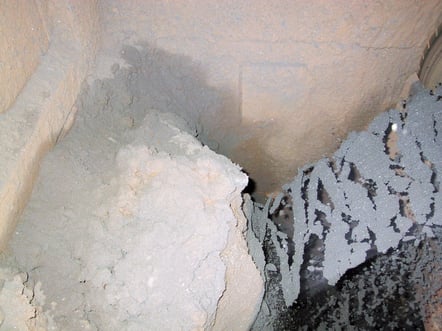
Transfer chutes should be fabricated in sections convenient for transport and on-site assembly. For retrofit systems, chute sections must fit through available openings to reach the construction site.
Care must be taken during chute construction to avoid imperfections that could disrupt material flow, undermining the carefully engineered design. Variations of ±3 millimeters (1/8 in.) may cause issues when aligning wear liners or aligning the chute with the belt. Investing time in precise chute installation pays off through enhanced efficiency, simplified maintenance, and reduced fugitive material.
*Air cannons safely, efficiently, and effectively help maintain proper material flow.*
Despite [best intentions and practices of transfer chute designers](https://foundations.martin-eng.com/en/knowledge/design-considerations-of-the-transfer-chute?hsLang=en), material accumulation can occur in transfer chutes, especially with moisture-laden materials that may freeze during winter. Continuous operation can compact material onto chute walls, leading to blockages. When designing chutes, it's prudent to plan for future flow-aid devices like vibrators or air cannons.
#### **Chute Access**
[Enclosed transfer chutes require openings for visual inspection and doors for worker access](https://foundations.martin-eng.com/en/knowledge/belt-conveyor-observation-and-inspection-doors?hsLang=en), with clear paths for workers to reach these points. Inspection openings, like [hinged access doors](https://foundations.martin-eng.com/en/knowledge/belt-conveyor-observation-and-inspection-doors?hsLang=en), should be away from material flow but accessible for personnel to monitor movement and inspect wear.
*Properly placed access doors allow observation of material flow within transfer chutes.*
[Screens or guards protect workers from pinch points](https://foundations.martin-eng.com/knowledge/equipment-guards?hsLang=en) and rolling components. Corrosion-resistant covers or doors should seal tightly to prevent dust leakage. Safety barriers prevent material escape and keep workers clear of the material path.
Often overlooked is the need for access to replace liners or maintain belt cleaners within transfer chutes.
Considering future service needs is crucial for smaller chutes where personnel access is limited. Fabricating chutes in sections facilitates easier disassembly for maintenance purposes.
- [Basics of Belt Conveyor Systems](https://foundations.martin-eng.com/knowledge/basics-of-belt-conveyor-systems?hsLang=en)
- [Conveyor Belt Mistracking](https://foundations.martin-eng.com/knowledge/conveyor-belt-mistracking?hsLang=en)
- [Belt Conveyor and Component Damage](https://foundations.martin-eng.com/knowledge/belt-conveyor-and-component-damage?hsLang=en)
- [Material Carryback and Belt Cleaning](https://foundations.martin-eng.com/knowledge/material-carryback-and-belt-cleaning?hsLang=en)
- [Material Spillage](https://foundations.martin-eng.com/knowledge/material-spillage?hsLang=en)
- [Belt Conveyor Safety](https://foundations.martin-eng.com/knowledge/belt-conveyor-safety?hsLang=en)
- [Dust Management](https://foundations.martin-eng.com/knowledge/dust-management?hsLang=en)
- [Material Flow](https://foundations.martin-eng.com/knowledge/material-flow?hsLang=en)
- [New Technology and Innovation](https://foundations.martin-eng.com/knowledge/new-technology-and-innovation?hsLang=en)
- [Belt Conveyor System Maintenance](https://foundations.martin-eng.com/knowledge/belt-conveyor-system-maintenance?hsLang=en)
[](https://foundations.martin-eng.com/en/knowledge?hsLang=en)
Foundations™ Learning Center
Copyright © Martin Engineering. All Rights Reserved.
**Think Clean®**